78 homes per month on average
Local Market Perspective
Read the market.
Move with context.
South Shore market conditions can shift by property type, block, condition, and timing. We help you understand the signals that matter for your particular move.
South Shore Sales Data
The latest six-month view
March–August 2026
All home types
Three-month rolling measure
39 days faster than March
What the numbers say
Activity strengthened while pricing stayed uneven.
Reported sales increased from 70 in March to 85 in August, a 21% rise. At the same time, the rolling median sale price finished 13% below its March level after reaching a six-month low in July.
By August, the rolling median market time had shortened to 62 days and homes closed at an average 95.9% of asking price. The combination points to quicker decisions, but not blanket pricing power for sellers.
- For buyers: movement improved, yet the average sale still closed about 4% below list price in August.
- For sellers: sharper summer activity rewarded accurate positioning; 26.7% of August sales finished above list.
- For everyone: property mix matters. Condos, single-family homes, and multifamily buildings can move the neighborhood median in different directions.
| Month | Homes sold | Rolling median price | Rolling market time | Sale-to-list |
|---|---|---|---|---|
| March | 70 | $187,500 | 101 days | 95.1% |
| April | 75 | $167,900 | 107 days | 94.9% |
| May | 76 | $144,500 | 101 days | 94.8% |
| June | 76 | $155,000 | 87 days | 95.5% |
| July | 86 | $143,000 | 77 days | 96.0% |
| August | 85 | $163,871 | 62 days | 95.9% |
Source: Redfin Data Center monthly neighborhood Housing Market Tracker, supplemented by Redfin’s South Shore market page. Data accessed September 12, 2026 and current through August 2026; all home types. Neighborhood figures use rolling three-month periods and may be revised. This summary is not a valuation of any individual property.
South Shore vs. Chicago
Where the neighborhood stands now
June–August 2026
Rolling 3-month period
South Shore is showing above-typical buyer activity and exceptional entry-price accessibility, but it has not yet matched the pricing strength seen across the middle of Chicago’s community-area market. That mix places the neighborhood in an early momentum phase—not a confirmed appreciation phase.
South Shore grew 19.1% year over year versus 0.9% for the median of other reported Chicago community areas.
A $163,871 median price versus $349,331 across the rest of the reported community areas.
184 available homes versus a rest-of-Chicago community-area median of 67.
| Indicator | South Shore | Chicago area median | Relative position |
|---|---|---|---|
| Closed sales | 85 | 52 | 24th of 74 by volume |
| Closed-sales growth | +19.1% | +0.9% | 15th of 73 |
| Median sale price | $163,871 | $349,331 | 3rd-lowest of 74 |
| Homes available | 184 | 67 | 6th-highest of 75 |
| Median market time | 62 days | 58 days | Four days slower |
| Average sale-to-list | 95.9% | 100.4% | Buyer leverage remains |
| Median-price growth | −14.7% | +7.7% | Recovery not confirmed |
Positive relative signals
More purchases at a substantially lower entry price.
Sales activity is growing much faster than the Chicago-neighborhood middle, and South Shore’s price position can keep it accessible to value-conscious and first-time buyers. Higher inventory also gives buyers more selection than in most community areas.
What still needs to improve
Demand has not translated into broad pricing power.
The average sale remains below list, inventory is 6.9% higher than a year ago, and the median price is still below last year’s level. Those conditions favor buyers, but they also mean a seller-side recovery needs further confirmation.
Conditional Positive Outlook
Activity first.
Pricing confirmation second.
The constructive scenario is that sustained purchase growth gradually absorbs available homes, shortens market time, and reduces the average buyer discount. These are conditions to monitor—not promised outcomes.
- 01
Demand holds
Closed-sales growth remains above 10%, showing that current momentum is durable rather than a one-period spike.
- 02
The market tightens
Inventory begins to fall and median market time moves below the current Chicago-area median of 58 days.
- 03
Pricing confirms
Sale-to-list performance moves toward 98%–100% and year-over-year median-price growth returns to zero or better.
Comparison source: Redfin Data Center, monthly neighborhood Housing Market Tracker, last updated September 3, 2026. Comparison medians exclude South Shore and use the other official City of Chicago community areas with reported values: 73 areas for most indicators, 72 for year-over-year measures, and 74 for inventory. Rankings include South Shore and therefore use totals of 74, 73, and 75 respectively. Redfin uses rolling three-month windows for neighborhoods and may revise its estimates. The outlook is scenario-based general market commentary, not a price forecast, investment recommendation, or guarantee of appreciation.
Development & Investment
Near-term forces shaping South Shore
September 2026
Status-checked snapshot
South Shore’s constructive case extends beyond today’s affordability and sales momentum. New housing and retail at 79th Street, a newly opened regional destination, a major technology campus rising nearby, and planned corridor work can broaden the neighborhood’s economic base. Their real-estate effect will depend on execution, local participation, and sustained demand—not announcements alone.
6001 S. Stony Island Ave. · immediately north of South Shore
Obama Presidential Center
The campus and Museum began welcoming the public in June, establishing a major cultural and civic destination beside Jackson Park. Its programming can bring recurring visitor activity and wider visibility to the lakefront communities around it.
Potential market channel
More visitor spending and event traffic can support nearby restaurants, retail, hospitality, and service businesses.
Watch: storefront occupancy, business openings, and sustained visitor activity.79th St. & Exchange Ave. · South Shore/South Chicago edge
Thrive Exchange South
The first phase is bringing 43 affordable apartments, ground-floor commercial space, and a permanent Neighborhood Housing Services office to a transit-served intersection. Leasing is now being marketed for the new residences.
Potential market channel
New homes, active storefronts, and daily services can add foot traffic and reinforce the 79th Street commercial corridor.
Watch: home lease-up, occupied retail space, and progress on later phases.Former South Works site · south of South Shore
Illinois Quantum & Microelectronics Park
The 128-acre technology campus is actively rising along the lakefront. Illinois has committed $500 million in capital support, while anchor tenant PsiQuantum and additional research partners are building a new quantum-computing and microelectronics cluster.
Potential market channel
Technical jobs, construction activity, suppliers, and new service demand could strengthen the wider Southeast Side economy and expand the nearby buyer and renter pool.
Watch: local hiring, supplier contracts, tenant arrivals, and completed facilities.79th St. · Chappel Ave. to Oglesby Ave.
79th Street corridor improvements
The Chicago Department of Transportation completed the bid stage for a South Shore corridor-improvement construction package in 2026. This is an advancing public-investment signal, though the project should not be treated as complete until an award, schedule, and construction delivery are confirmed.
Potential market channel
Better corridor conditions can improve access, visibility, and the setting for local businesses and future private investment.
Watch: contract award, construction notices, final scope, and completion dates.The Measured Positive Case
Three demand engines.
One test: delivery.
Destination
The Obama Center can create repeat reasons to visit the area and increase regional awareness of the South Lakefront.
Employment
The quantum campus can add a new high-skill industry and supporting business ecosystem close to South Shore.
Neighborhood reinvestment
Thrive Exchange and 79th Street improvements can translate larger regional momentum into local housing, services, and street-level activity.
Project status sources: Obama Presidential Center, Thrive Exchange, Illinois EPA and Illinois DCEO, and the City of Chicago’s 79th Street procurement record. Status checked September 12, 2026. “Potential market channel” statements are reasoned scenarios, not measured impacts. Nearby projects may influence South Shore without being located inside its official community-area boundary. This is general market context—not a property-value forecast, investment recommendation, or guarantee of appreciation.
Beyond the Property
Culture, leisure &
ways to get around
South Shore area guide
Local and nearby options
A home search is also a daily-life decision. South Shore combines lakefront recreation and neighborhood cultural spaces with access to major South Side museums, arts destinations, downtown rail service, and cross-city bus connections. Programs, hours, and transit schedules change, so confirm details directly before visiting or traveling.

Culture & Entertainment · In the neighborhood
Historic spaces with active programming
The South Shore Cultural Center brings together landmark architecture, the Paul Robeson Theatre, an art gallery, a music library, classes, and community events. Nearby, the Stony Island Arts Bank presents exhibitions, Black cultural archives, music and listening programs, and changing hospitality concepts.
Good for performances, exhibitions, classes, community gatherings, and special events.
Museums & Arts · Nearby
Major institutions close to the neighborhood
Jackson Park, Hyde Park, and Washington Park add a deep cultural bench: the Griffin Museum of Science and Industry, the DuSable Black History Museum, and the University of Chicago’s free Smart Museum of Art. The Obama Presidential Center adds another nearby museum and public-programming destination beside Jackson Park.
Check exhibition calendars, admission requirements, and installation closures before a visit.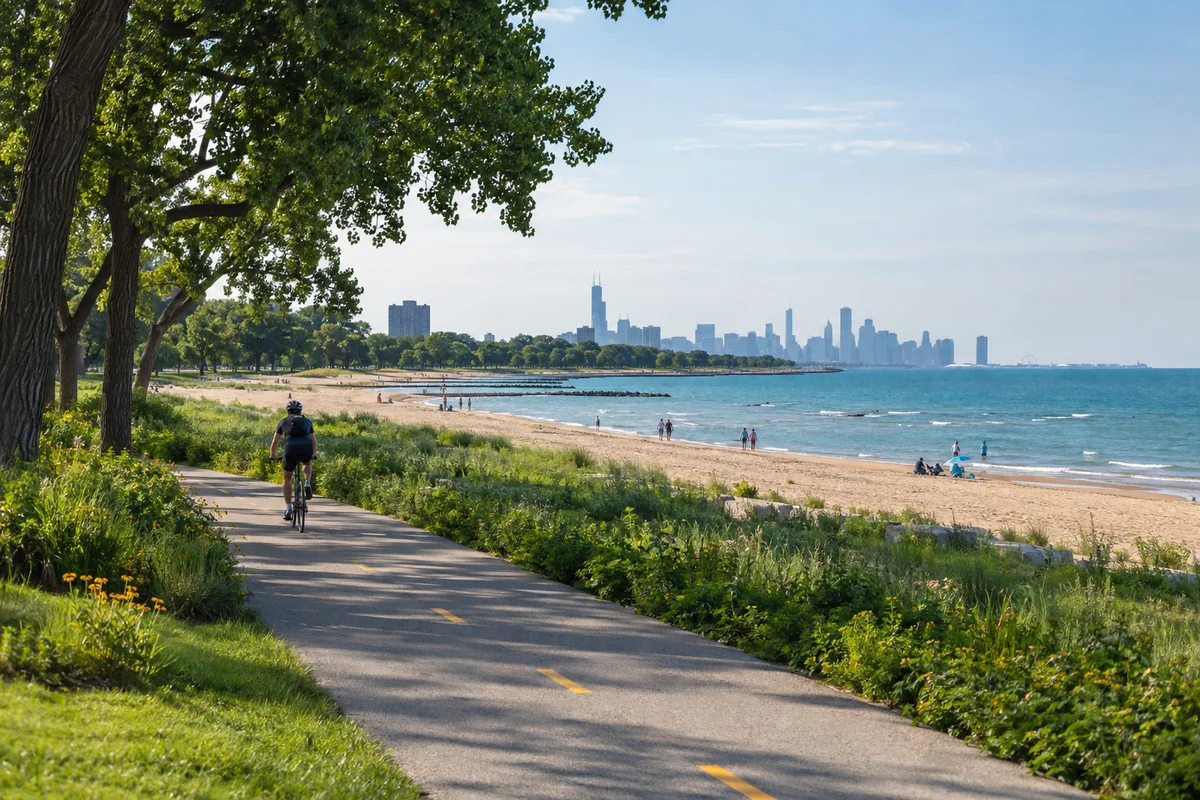
Lakefront & Recreation · Close to home
Beach days, trails, golf, and open space
South Shore Cultural Center Park includes a beach, nine-hole golf course, tennis, picnic areas, and the six-acre South Shore Nature Sanctuary. The separated pedestrian and bicycle Lakefront Trail reaches 71st Street, while nearby Rainbow Beach Park adds a beach, boat launch, sports courts, playgrounds, and dune habitat.
Seasonal access, swimming conditions, and program availability vary throughout the year.Transportation
Several ways to connect.
Exact convenience depends on the address and time of day. Use current trip planners when comparing a home with work, school, and regular destinations.
Neighborhood-resource sources: Chicago Park District, Rebuild Foundation, Griffin MSI, DuSable Museum, Smart Museum, Metra, and the CTA system map. Details checked September 14, 2026. This is a selective neighborhood overview, not a complete directory or a guarantee of travel time, availability, or future service.
What We Watch
Four signals behind every move
Signal 01
Availability
The homes and rentals that match your needs, how much choice is available, and how quickly suitable options move.
Signal 02
Pricing
Recent comparable activity, current asking prices, and the competition surrounding the property type you are considering.
Signal 03
Condition
Renovation quality, maintenance needs, and building considerations that can materially change value and monthly cost.
Signal 04
Location
Block-level context, transit access, proximity to the lakefront, and the housing patterns that make each part of South Shore distinct.
Buyer & Renter View
Know what the asking price does—and does not—tell you.
A useful comparison goes beyond the headline number. We look at the home, building, location, condition, and terms together so you can judge the full opportunity.
- Compare similar properties on a like-for-like basis
- Understand tradeoffs between condition, location, and monthly cost
- Recognize when speed matters and when patience creates leverage
- Build an offer or rental approach around your priorities
Read
The context before you act
Seller View
Position with the market, not around it.
The strongest listing plan reflects what buyers are seeing now. We connect preparation, pricing, presentation, and timing so the property enters the market with a clear purpose.
- Review relevant nearby and property-type comparisons
- Identify preparation work that supports the market position
- Set a pricing range grounded in the competitive landscape
- Adjust the plan as buyer response creates new information
Plan
For the market in front of you
Current Context
Let’s look at
your part of the market.
Market conditions change. Tell us what you are considering, and we will start with a current, property-specific conversation.